Showing posts with label Essays. Show all posts

IFS Fractals Maximize Artistic Complexity

The most fundamental aspect of creating a visual artwork, a copy of either an existing or imagined object, is that of estimating the relative proportion and angle of some part to another, whether working based on a model or from imagination. These two aspects characterize the creation of forms in the piece, as well as their overall composition. Specifically, during the creative process - as reasoned an iterative one in time - the artist uses reference points to lay out the composition, of the whole and the parts. In fact the process may be said to be fractalline, in that the artist transitions between working out global and local details, often in progressively smaller regions. Meanwhile the proportion and angular relation of reference points serves the interpolation of curves to create forms / contours. From there, the rest of the task is shading or coloring. (Though the above steps often occur in a parallel and random manner, as discussed in earlier essays.)

Therefore the artistic process hinges on the two aspects of estimating relative proportion and angle, and the following philosophical question arises: what type of object poses the greatest complexity with respect to the described creative process? We reason that it is an IFS fractal, through modelling the creative process as the "copying" of existing or imagined visual objects.


A two-map IFS fractal.

Clearly an object which has infinitesimally fine features (such as a fractal), beats any other object in complexity which has none. The mathematical compactness of the object is necessary for the convergence of the iterative copying process from global to local features / regions. Partitioning these features into discrete levels from larger to smaller, in a way that the features at each level contain the next, the iterative copying occurring level-by-level. The relation of a higher level iterate to its subiterates may be assumed to be a similarity transform, possibly involving sheer. The level structure tree can be assumed to be n-ary on average and the relations to be a set of similarity IFS not involving sheer, without relevant reduction of creative complexity to be manifested via the copying process.

Therefore we have reduced the class of highest complexity to that of similarity IFS fractals with n maps. Iterating to infinity, the attractor of such an IFS - the n-map IFS fractal - is thus an object of highest possible creative complexity.

In practice, by the equation H(F)=F (where F is the IFS fractal, and H is the Hutchinson operator induced by the IFS) the task of creating / copying F via a global to local iterative process, involves copying the convex hull C (or its vertices) and making n copies Tk(C), k=1,...,n (by each IFS map Tk). Then we execute the Hutchinson H on these copies, and so on, iterating to a "high enough" level, approaching infinity. Each level being the aforementioned next level of features / regions / convex hull iterates. The challenge of complexity being the proper execution of the Hutchinson by hand drawing - proportionality and angular errors apt to accumulate, signifying the complexity.

The above argument further illustrates how a visual artwork can be characterized as the attractor of the creative process (ignoring shading / coloring), as reasoned earlier.
 

Postscript to my Definition Attempts for Art - Part 3/3

Continued from Part 2/3: Artworks as Attractors in Practice.

As a postcript, I must mention the taboo these essays are breaking. For in fact today it is a taboo to talk about a definition of Art, because it is considered undefinable due to the currently prevailing ideas of "freedom of creation / interpretation". In other words, it is up to the viewer to decide if they consider something Art or not, worthy of their appreciation. This is a rather over-simplified and rarely-doubted view, analogous to early Humans' worship of what they could not explain.

In these essays, I am suggesting a meta-definition existing independently of viewers or creators, since I believe that Art does exist on the meta level, and it does have a genuine universal definition, which may or may not be the ones I have proposed. However I do believe in the validity of my second (current) definition, as it is closely based upon my own experiences and inner feelings while creating. A more refined definition will only be possible if we uncover the biological mechanisms of artistic imagination within the brain, or possibly beyond it.

Deep inside everyone feels that this quest for the true definition of Art is a potentially dangerous one. For if a rational/algorithmic method gets to be devised for creating an artwork, computerized machines may then be capable of envisioning, generating, and improvising genuine refined true Art, likely surpassing any Human Art. Many types of generative media already exist, including fractal art and abstract video art. However, I mean here algorithms capable of turning a piece of marble into a piece of Art, due to their ability to envision and improve a piece via their non-deterministic Taste, resulting in various Artworks from the same piece of marble. It is no surprise then that a deep fear resides in us for such an ominous possibility, which might easily surpass any visual art formerly created by a Human.

However, I believe that Homo Sapiens won its dominance due to its intellect in devising tools to extend its abilities. Machines aiding the creation of Artworks through mathematics and programming, only represent new brushes, canvases and chisels for manifesting Human visions in reality. So then what is a greater quest than devising machines capable of envisioning and creating Art in a split second?

In the future, artists must also become mathematicians and programmers, and that time is not far. As a first stage, their art may very-well become a combination of Human improvisation using computer-generated elements, resulting in a sort of performance-like "Cyber-Human Art", described in my essay On the Future of Art.

As I wrote in that essay: "I hope that today’s generation of artists will remain open to any new advancements, and will profit from these opportunities when they become available, thus allowing themselves to open doors to higher levels of creative freedom."
 

Artworks Are Non-Deterministic Attractors in Imagination Space - Part 1/3

My earlier essay A Definition of Art suggested a theoretical yet statistically verifiable definition for the term "Artwork". The impracticality arises from the fact that the true (non-approximate) version of that definition depends on knowing the theoretical "Taste of God" - so it is also a deistic definition. The statistical side of the definition arose from approximating this opinion with the opinion of numerous Humans, who might carry a partial divine light within.

In this essay, I intend to give a non-deistic definition of an Artwork. However, some certain mechanisms of it are mysterious enough to possibly still require a "divine light" to act. At the moment, my definition is still hazy to me, and this essay is only a sketch of a potentially deeper theory yet to unfold.

As mentioned in my other essay, once the concept of an "Artwork" is defined, "Art" is simply the set of all Artworks, and an "Artist" is someone capable of making an "Artwork".

Here we will assume the pre-existence of an "inspiration" or primary impulse producing a "vision" which the rest of the creation process follows in an approximate manner. The end result may in fact significantly deviate from the preconcieved vision. (Note that I prefer unaided artistic visions.)

To begin the definition, first we will define "Taste". Let Taste be a finite set of contractive transformations (mathematical functions in the sense of Iterated Function Systems), which each transform a perceivable object into another, in one step. Define an "impulse" as a specific contractive transformation of Taste.

Note that here "perception" is that of any conscious being (whatever consciousness means), not necessarily a Human, and the object may be visual, written, auditory, or other. What "contractive" means, is unclear to me at this point, but it certainly means that in an abstract space (not mere 3D), a certain mathematical measure (abstract volume) of the Artwork gets smaller due to the transformation. This abstract measure could be beauty, ugliness, dynamism, etc. depending on the impulse's given function in the abstract space. Let that abstract space be called (Collective Human) Imagination, and let the transformations of Taste (impulses) be operators over that space.

The impulses likely have two main classes: creative and corrective. Creative impulses bring new elements into the object, while corrective impulses merely modify the object, or its certain part(s). The new elements could be the overall composition, color and tone patches, new note in a musical score, etc.

A crucial question is how impulses act in time. Do they act one after the other, or in a parallel manner? In the second case, which is implied by Human brains being parallel processors, the impulses create a multilayered flow of creation, which nevertheless has a finite number of layers, as many as the impulses. Since for instance if there are ten acting impulses, each of them act sequentially by themselves, creating an individual sequence. So ten parallel sequences will make up the flow of creation. In the first case, there is only one sequence of impulses, where each sequence element is due to one random impulse.

How do impulses acting in parallel create a new object as a whole? Each individually produces a result, but how do the results get combined? Possibly via a weighted average of the individual results, or by a simple set union, or there may be one additional complex "master impulse" directing their combination.

What is the nature of the transformations? Are they genetically ingrained, learned over time, or inspired by a divine light? Possibly their biology have components due to each. This is the mysterious, potentially deistic point in my new definition. Impulses certainly have an evaluating element of the object under transformation, and they produce a result based on the evaluation.

Impulses may not be deterministic, due to the fact that the Human brain is non-deterministic to an extent. In practice this means that Humans have "opinions" that may change - in other words for the same input, the brain produces a different output at a later time. The actions of impulses may vary similarly to some extent, based on probabilistic factors due to hormonal, emotional, etc. changes in brain chemistry, or for other reasons, at any moment.

We have now arrived at defining an Artwork. The initial object which is acted upon by the impulses, could be anything. Visually it may be a blank canvas or a heap of trash. Define an "iteration" to be one acting step - when the impulses act in parallel to transform the object into a new stage (some impulses may skip acting in an iteration), while combined via a master impulse.

Thus the impulses transform the object iteration by iteration, acting upon the previous result in a recursive manner. Since impulses were defined as contractive in the abstract space of Imagination, we thus have a contractive Iterated Function System (IFS) which by the Banach fixed point theorem has one unique fixed point, as the iterations tend to infinity. Let this fixed point / attractor be called an "Artwork".

Continued in Part 2/3: Artworks as Attractors in Practice.

Artworks as Attractors in Practice - Part 2/3

Continued from Part 1/3: Artworks Are Non-Deterministic Attractors in Imagination Space.

During the creative process, how does one know if they have arrived close enough to creating an Artwork (after many iterations)? The solution is trivial and in agreement with what an artist instinctively does: one must apply their Taste to transform the object, until an application results in no further improvement. In other words, Taste produces the same object after any new iteration. This is also a sign that Artworks are indeed fixed points of an artist's Taste.

Individual observers may test if something is a good candidate for being an Artwork, by applying their own Taste to it, and if their Taste is universal enough (close enough to some ultimate Taste, possibly that of God) and the artist's is universal enough as well, then they should arrive at the creating artist's conclusion, that the piece indeed cannot be improved (within its own theme and context). Note that there must likely exist an ultimate High Taste, as also conjectured in my essay A Definition of Art.

Let's discuss our new definition and the above in practice, regarding Human visual artworks. When someone looks at an object, say a piece of stone, they may see certain parts which seem out of place by their Taste, so they wish to "fix" it by chiseling that part. When they again look at the stone (evaluate it with their Taste), they may find another part to correct, and so on. Someone with a very refined Taste (an Artist) would likely continue on for many-many iterations, to "perfect" the stone to their liking (Taste). The iterations may follow one another in the split of a second, making the process look continuous. When a painter paints, s/he is able to bring new creative elements in and modify the existing ones (by their impulses of Taste). Thus iteration by iteration they get closer and closer to a fixed point, or Artwork, which theoretically is impossible to improve, thus they reach a fixed point (an attractor).

Note that the iterations may start before the physical object is created/transformed in reality, since the Artist may create in advance, or in "imagination", before actually acting on their creative impulses. The creative act is usually the result of a mysterious "inspiration". Imagining in advance, may serve the purpose of coming up with alternative results over some iterations, projecting creation into the future, and picking and taking the most desirable route.

From the definition, it also follows that it is impossible in practice to create an Artwork, since an infinite number of iterations are necessary to reach one. We can only go down the infinite sequence of iterations to a very large number, and if one's impulses are "acute" enough, the process should be efficient and practical enough to arrive at a near-Artwork.

Note that in this definition "Artwork" is analgous to "true Artwork", and "near-Artwork" to "high Artwork", as defined in my previous essay. "Low Artwork" would correspond to a low iteration number, thus an object not sufficiently refined by the iterations of Taste impulses.

My definition is again in full agreement with Michelangelo, who said:
"The true work of Art, is but a shadow of the Divine Perfection."
For we may only reach a finite number of iterations (a shadow), from the infinite number necessary to create an Artwork (divine perfection). So "visual value" or the quality of an artwork, is really just the level of refinement due to the number of iterations carried out by the Artist according to their Taste.

The above also sheds light on certain aspects of visual creation. One is that artists tend to create from sketchy to refined forms, the refining taking place in smaller and smaller regions - just as IFS fractals appear (which are also attractors in 2D space, not Imagination space). It also shows why imagination in its freest form contains so many spirals, since they are basic fractals/attractors themselves. Impulses creating IFS fractals are simple mathematical mappings, which in words state: "rotating, transposing, and contracting an object will make them 'look better'", and two or more impulses create an IFS fractal.

An Artwork will become energetic in composition, due to the increased Taste for motion, resulting at the extreme in visual elements flowing turbulently at high Reynolds numbers. The theme of an Artwork may heavily influence the impulses in creating an Artwork, thus turbulence may not always be desirable, while in certain other cases it may well-serve to increase visual value as described in the Energy Art Movement Manifesto.

Continued in Part 3/3: Postscript to my Definition Attempts for Art.

Visual Art in the Internet Age

written on April 3, 2009

I see six major consequences of the Internet Age to the World of Visual Art. They are:
  • exposure of individual artists
  • interaction of various artists
  • smaller significance of galleries
  • smaller significance of mediums
  • greater significance of visual quality
  • young people's perception of art.
I would like to touch on each briefly below.

Just like in other professions, there have always been artists who could "sell" themselves and those who couldn't, regardless of their talent or the quality of their work. The internet provides a more efficient way of exposing oneself to the world at large. As I have seen with some other artists, hard work both in their art and in their marketing, generally translates into monetary gain and recognition. But there are also those artists who do little for their own exposure and only concentrate on the quality of their work, and sit around waiting for a miracle to bring them recognition. Then there are those who are good at "selling" themselves, but lack quality. 20th century art was run by those people, but they will soon lose their prominence as I describe below.

To continue with the most elevating effect of the internet - at least for me personally - it has brought us the chance to explore and interact. I think it is a wonderful feeling to know that we are not alone in "that" art world. For me the Energy Art Movement is a culmination of this effect, and I can't imagine doing anything that I would be more motivated by when it comes to meeting and promoting genuine artists. I also enjoy meeting young talent, especially on Deviantart. Exploring fellow artists' work, one also gets a good idea of where to improve.

The chance of promoting one's work and interacting with others, adds up to an opposing force to the significance of galleries. Not that they necessarily need to be opposed, it is just an unavoidable consequence. I don't believe that physical commercial galleries will disappear anytime soon though. But it is certain that artists' websites and online marketplaces - for both originals and prints - will be the dominating method of sales in art in the very near future. The people are finding it more and more absurd to visit galleries in person, and instead of traveling they just browse their websites and order online. The same is true for individual artists. So the future will be all about how good you and your work looks on the internet. I also see more and more artist collectives forming, which means artists are realizing that together they stand a greater chance than alone.

As a consequence of the above, the medium in which your artwork was made, will become less significant as well, since only its "image" on the internet and the presentation of it on your website is going to matter. People will buy more and more of their art on the internet, so they will turn to buying prints, besides shopping at marketplaces like Ebay or Etsy for original art. So artists must keep this already occuring transitions in mind, and stay ahead of the wave.

Again as a consequence, the quality and impression of the "image" of the artwork is going to gain greater prominence. The new "judges" of the art world are not the collectors or the gallery owners anymore, but the general public and the young kids on Deviantart. They will soon grow up and with the real art in mind that they saw and collected online, they will sweep aside all the overeducated nonsense of the 20th century, simply by their freedom of choice what to buy, again online. New York is already feeling the transition, and attempts to react by infusing more and more hyper/academic/neo-realism into their repertoire, but even that is not going to work. It is mere backward evolution and a weak attempt. Dalí was right in saying that the art of the future is surrealism, but only an artist or appreciator who has genuine artistic sense, can "see" why.

Young people's perception of art will soon spring forth from their own inner self-confidence. Everyone is born with some level of genuine artistic sense, which later on gets overridden by the opinions/choices/dictation of artists/galleries/collectors and other "respectable" figures who they so far lacked confidence to question. But since children interested in art, will now grow up in an art-saturated internet environment, they will inherently develop confidence in their own opinions, which is founded on their true natural inner artistic sense that cannot mislead them. Whether they will prefer lighter or darker art, they will seek out quality work. And this effect is true for everyone, not just artistically-talented children.

So anyone who has created quality art up to now and from now on, will have a much greater chance to be fairly appreciated by some segment of the public. But we as artists must not forget that our duty lies not only in depicting our visions to the best of our abilities, but also in delivering it to the public through as many channels as we can manage. Self-promotion coupled with talent is not a vice but a virtue. The quality that one strives for, should be interrelated with the confidence one has to promote oneself.

Drug Use in the Artistic Creative Process

written on March 31, 2009

I have been asked to clarify my viewpoints on this issue on various occasions while organizing the Energy Art Movement. In this essay, I would like to summarize and extend my opinions further. I hope that the reader will ponder its points, and find both the truths and flaws either in my ideas or their own.

I am certainly not the movement, and my opinions are not necessarily its principles. The principles of the movement include a neutrality clause which clarifies our collective standpoint over psychedelic substances, such as LSD. This means that their use cannot be promoted on behalf of the movement, nor can it be discouraged. Even outside the movement, I think it should be a private matter for everyone. I personally don't consider the promotion of drug use a good idea, as it can harm the artist's reputation and that of any group they are associated with. These drugs are currently illegal in most countries. Furthermore, it is unfortunate that in visionary art - on behalf of which drug use is often promoted - only a small percentage of artists use drugs for creation, but the overall impression of the outside world is that visionary art is a subset of psychedelic art, when in fact it is the other way around.

The neutrality clause is also meant to leave the movement open to rigorous scientific results of the future. These results might have an effect on some of these drugs' legality. Research may also shed light on the science behind the psychedelic spiritual experience. It is quite possible that in the future, psychedelic substances will become a part of main religions' spiritual practices, once science enlightens us on the precise nature of their effects, and provide us with proper safety precautions. While they can induce wonderful spiritual experiences, and assist us in our inner psychological enlightment, they can also take us to the depths of hell, without us signing up for the "bad trip".

Besides the legal, scientific, and spiritual viewpoints, we must also look at the issue from an ethical viewpoint. There is a fine line of distinction between two ways artists currently use psychedelic substances related to their creative processes. I personally don't consider either to be fully ethical, but I find the first somewhat acceptable. The first method is when an artist takes some psychedelic substance, trips for a while in either their inner or higher realms, and once fully back in reality, intends to share their visions with others in the artworks they create (visual, music, or else). Since interdimensional cameras have not yet been invented, these artists choose to act as photographers of their visions, which I think is ethically acceptable. The second way artists use psychedelic substances, is when they create their works while on smaller doses of drugs, less interested in visiting higher planes, and more in boosting the muscles of their imagination. This is no different than using steroids to boost one's performance in sports, the artists' muscles being their imagination. This second method is clearly unethical, and should be distinguished from the first.

In relation to the above, another point is worth making. Just as in sports, if one has a less-developed musculature, the steroids will only help them boost their performance to a certain extent. They may still be easily surpassed by other sportsmen with much more developed musculature, and not making use of steroids. So a lightweight boxer on steroids might be a match for a middleweight one, but not for one in the heavyweight class. So essentially, if one doesn't strive to develop their muscles through natural means, they will eventually be surpassed. Drugs are an imagined crutch, which may prevent the artist from self-development through natural means, and entering the arena in full vigour. Note that while many like to think that the Fine Arts is not a sports event, you are not likely to succeed if you don't strive to excel in your craft, often with the intention of furthering and surpassing what you have seen before.

I consider the best way to develop one's imaginative muscles to be through meditation and subsequent picturing of realistic/surreal/abstract scenes in one's mind. Meditation results in a crystal clear empty mind, a white canvas for painting one's evolving ideas over it. While in this ideal state, one can try various color schemes and compositions in their mind, and attempt to find the best one for the concept. If one prefers improvising instead, starting with a meditational session will also help them in the flow of ideas as their improvisation evolves on the paper/canvas/screen.

To get back to the issue of drug use promotion among artists, we must not forget the responsibility we have towards budding artists. I find it unfortunate if a well-known visionary artist openly promotes drugs, not only psychedelic ones but others as well, such as ecstasy or marijuana. This is sad because young artists may get the impression that in order to create as accomplished works as their respected idol, they must also reach to drugs. This is certainly false. They may even surpass their idols eventually, using only their natural abilities - as discussed in the fourth paragraph - so young artists must realize and keep this mindset instead. This is the right path towards their personal development, and thus the collective evolution of the Fine Arts to a higher level.

As for why psychedelic art is often energetic, I think the reason is that imagination in its freest form is necessarily dynamic / energetic. In any case, drugs can surely free you up, but I suggest, try to be your own drug instead. As Salvador Dalí said: "I don't do drugs. I am drugs."

A Critique

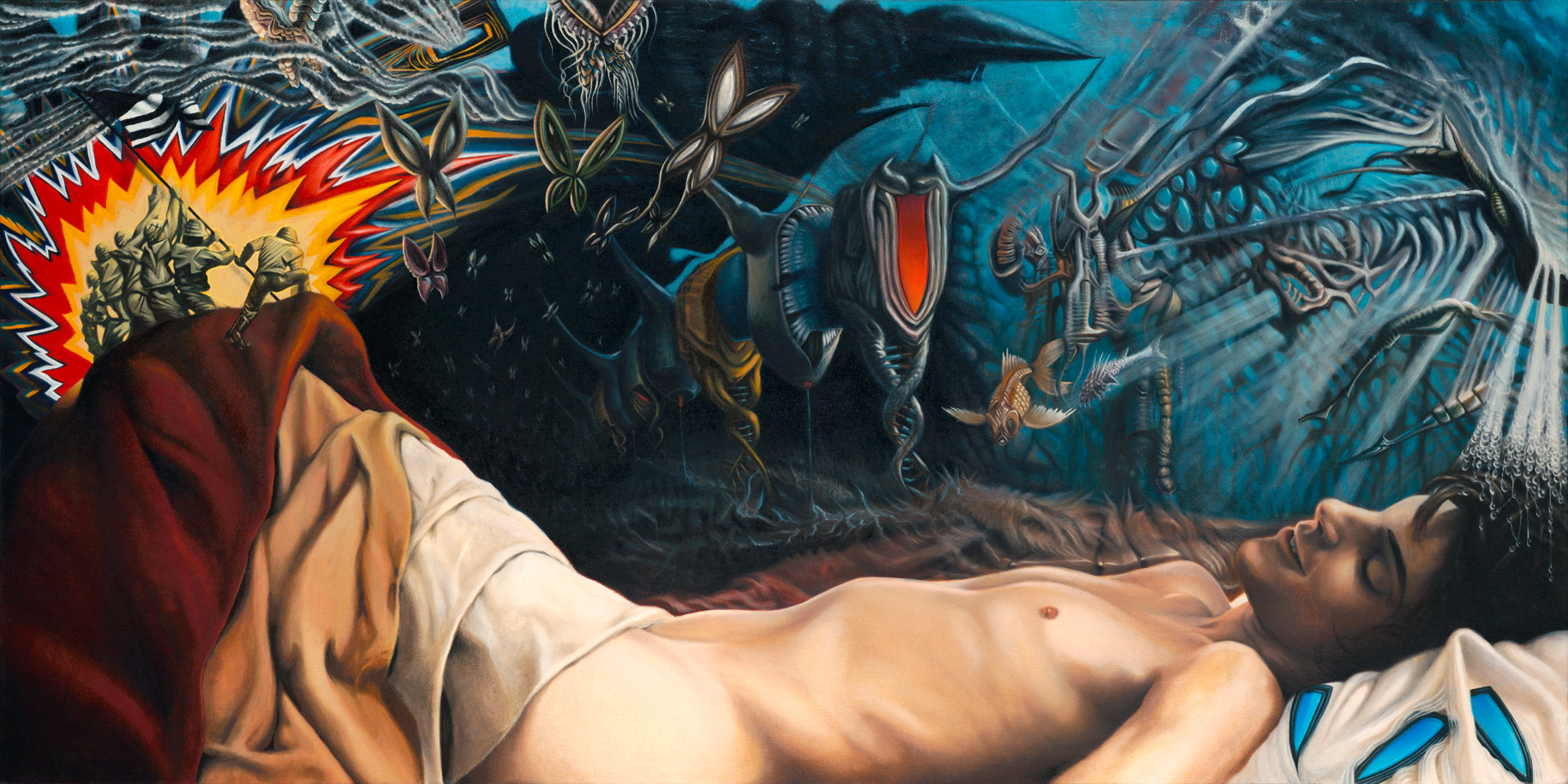
A critical account of "The Approach of a Great Threshold" by Cody A. Seekins
written on May 4, 2008, revised on Dec. 13, 2008


Introduction

Mr. Seekins presents us a magnificent work of art straight from his subconscious that holds mysterious yet discernible aspects which he describes briefly as follows:

"This piece is an interstice in time and relation. It speaks on many levels of the moments before manifestation, when much of the world of perception appears as a dream."

The painting guides us into a surreal world that Dali may have perceived as a result of his Paranoiac-Critical Method for depicting visions of the subconscious. The method serves to enhance artistic creativity, according to Dali by a "spontaneous method of irrational knowledge based on the critical and systematic objectivity of the associations and interpretations of delirious phenomena." As this article will show, the painting well exemplifies Dali's psychological method while doing much more: telling us a tale of our own hidden inner self, a shocking one indeed that really should be no surprise to one for whom meditation upon one's psyche is a usual practice.

Interpretation

Let us begin our interpretation, by first clearing our minds, shutting down outside distractions, and looking at the picture as if anew, and becoming one with the untouchable essence and atmosphere it radiates. Instead of forcefully trying to sink our teeth in any certain part, and suck the meaning out of it, let us allow ourselves to soar along the sky of the world it creates within us. Let us look into the vista, and see it both as a whole, and as the sum of its parts.

The first thing we notice, is the beautiful landscape of the youth's tender body, a tribute to the sensuous legacy of Michelangelo and Caravaggio. We fly along its hills and valleys, exploring, marveling, feeling what the painter may have felt as he painted with great dedication and expertise the subject of his desires. Even if we don't quite share his attraction, we can feel and soar along with him. Then we may wander with our eyes, still oblivious to the true nature of the pleasant-looking sky, to the pillow his handsome face rests upon, and notice something unusual. Eyes of striking blue, frightening in their surreality, watching watching and watching endlessly, this peaceful Adonis. We may start feeling awkward or guilty, that we are watching along. Our wings may start to shake in our fright, not so sure anymore that we want to fly over this surreal vista. Yet we fly along, responding to the painter's hypnotic persuasion.

The sparkling quanta of light on his hair, lead us along their rays to a complex structure, likely representing the complexity of thoughts and feelings, with its foundation on the ragged surface of the mind. The structure is not nice and flowing, smoothly to unite in a complex yet clear logical mindset, but instead quite the opposite. It is a horrifying structure that can unite into equally complex yet evil thoughts, of the worst possible type: contagious and corruptive. What is its purpose, what is it about to corrupt? The most important question of all: whose mind is it? The painter's? Or is he luring us into a trap where his mirror will show our own corrupted self?

Then we notice the butterflies, dear friends of our innocent childhood, soaring towards us, raising the question "Why?". What is in the abyss which makes them fly in the opposite direction, towards us? Then we see some unusual ones, transformed into otherworldly creatures we don't recognize, further increasing our fright, which are transformed by tentacles reaching out of the structure of the mind. The wings of the untouched ones seem now like watching eyes, reminding us of our guilt, that we are watching too. Some others are transformed as if corrupted by some evil force. Butterflies, themselves a symbol of metamorphosis, from a pupa (chrysalis) into the most beautiful creations of the High Entity, are now further transforming, but this time not of their own natural will.

The boy himself represents transformation in his stage of adolescence. Will he be transformed any further by the evil force, as an analogy to the butterflies' metamorphosis? Will the evil force corrupt his soul? Will we transform alongside him, due to our flight over this strange vista? Or will we just recall something in us that has transformed us so deeply already? Is it all just a bad dream that will pass without any lasting effect, and we are just dreaming along with the sleeping boy?

Let us return to and concentrate on the abyss from which the butterflies emerge. It may very well represent the depth of our imagination, that can give birth to both the beautiful and the ugly, and the good and the evil. The progression of the butterflies is accompanied by a monster-train-like emerging vehicle. Transporting what? Resources for the mind's dark self from the abyss? The fish can barely get out of its way, while also being transformed by the evil spell. The watching one may once have been a shiny goldfish, the other we can no longer tell, the transformation is so complete. The monster is also watching along with us, its red eye pulsating, suggesting yet hiding its evil plans. Does it represent the infinite train that goes all the way to the bottom of the abyss, to bring forth resources to corrupt what the butterflies intend to make beautiful? The vehicle has separate but connected cells, like a train of thoughts or intentions, waiting for execution. All connected to the mind's surface, or our human nature. One by a DNA double-helix, the next by a simple weak rod or wire, as if one were programmed in our human nature and generated from it through the DNA, and the next is rather supported or implied by the cells before and after it, having just a weak connection to our programmed nature. The latter represents the implicative, the former the innate.

Lastly, we are left to wonder about the Pop art Lichtenstein-style depiction of the Iwo Jima Memorial in Washington D.C. The depiction seems out of place, perhaps meant to shock. To scream in our face, from the summit of the hill-like drapery, and announce the victory of the dark side, that we have so far been left to hope not to occur. The flying black flag stops us in our own flight of exploration, ending our state of trance, forcing us to the ground, only to realize the painter's message. We are back to reality, with a very realistic message from a surreal world.

Technical Details

Positive critique:

The composition can be considered elliptical, with its focal point in the abyss. Alternatively, it can be seen as vortical, with the abyss being the starting point of the elongated vortex, moving along the monster train and the structure, joining with the light rays, touching on the youth's face, moving along his curved posture, continuing in the flag on his knee, and further along the pointed canopy of darkness. I prefer the latter. It provides the painting with a classical type of baroque dynamism, that leads the eyes and holds the viewer's interest.

The realistic parts show a thorough understanding of anatomy and drapery, both in form and color. The variation of hues on the body, are ones which no photograph can capture. The drapery is masterfully laid along his leg in three colors, matching the red-yellow-white of the pop-explosion, yet contrasting its complex flowing forms to the ragged simplicity, showing a playfulness of the painter's visuality, making us smile when noticing this visual joke.

Most importantly, the conceptual nature of the work, and its great depiction, makes it a highly unique piece.

Negative critique:

I feel that some of my more negative observations are worth mentioning as well, not to defame, but to point out what can be improved in future works of the painter, that will hopefully be numerous.

I find the face of the boy to be too shadowed compared to the rest of his body, which may very well just be a dark cloud passing over him, as suggested by the theme. Yet considering the ray of light, and the overly light left-side of his body, the shadow-scheme seems inconsistent.

Furthermore, I found it unfortunate to separate the right abstract structure from the darkness of the emerging abyss, so abruptly with the monster-train, without providing proper visual reason. However, the horns of the monster seem to support and carry the darkness as if a canopy above it. Nevertheless, I found this depiction somewhat unclear.

The style of abstraction is reminiscent of the horrifying dreamworld of Giger, perhaps even too much, but it is very appropriate for the painting's theme. I feel that Giger's visuality is best applied, if taken further, significantly altering it, even if founded upon it. The artist must attempt to disconnect even further from his major influences, in order to develop a style truly his own. The Dali-like crazy ingenuity however, is well enhanced with the artist's intelligence and logic. Meditating upon new ways of depiction in general, will likely bring the painter to a higher level, that may surpass his predecessors.

Conclusion

The artist decides once and for all our inner dilemma between what we should prefer in our imagination and why. Beauty is represented by the nude boy and the butterflies, holding the potential of transformation within. The weakness/tenderness/softness/fragility of beauty is contrasted with the strength/ugliness/harshness/eternity of the monster, carrying within itself the power to corrupt the former. It further shows us our own weakness in this subconscious dilemma, and our wicked attraction to both, deciding the undecidable.

The painting can be considered an excuse to depict an ignudo, in a conceptual and meaningful setting, telling us a very honest confession. Furthermore, the depiction can also be considered a mirror of our own mind. Imagine in place of the attractive youth, your own personification of desire, and you get a reflection of your nature in a similar atmosphere.

Regardless of any shortcomings, I believe this work is an exceptional masterpiece, and belongs to the hall of those select few.

Personal Note

I feel very fortunate to have found this painting two days ago, because it not only shed light on - or rather reminded me of - my human nature, but it also helped me decide what work should be the subject of this first critique article of mine. The fact that it recently received a Daily Deviation on DeviantArt, a questionable label, did not influence me the least, and in fact I honestly noticed it only after finishing the draft to this article. The purpose of the article is primarily not to promote the painter, but to provide a general discourse on conceptual visuality, that we may all benefit from, while giving an idea to the reader of what I think an art critique should look like, in this decadent age. For me, the painting was both an exciting endeavour, and a useful learning experience as well.

A Definition of Art

In today's world, one might feel that we live in a decadent pop age, where the words "art" and "artist" have become commonplace and meaningless. So I felt it necessary to attempt a possible definition of true art, which might inspire others to create better ones.

"Aesthetic quality" will hereby refer to the assessed overall impression of a non/physical object to the human senses, including the mind and soul - as such a mathematical function over all perceivable objects. "Aesthetic change" will refer to a positive/negative change in aesthetic quality. A positive change will be referred to as "creation" and negative change as "destruction". A sequence of such changes will be referred to as a "creative process".

A "true human artwork" is the result of a human creative process, meant to be perceived by one or more of the human senses, created in such a way that it seems to be a well-above average - or even superhuman - feat to a large enough portion of a diverse enough set of human observers, sufficiently representative of the full human population in existence. These human observers must appraise the aesthetic quality of the result deep inside their soul, with their inherent aesthetic sense. A human artwork must also especially evoke the aesthetic appreciation of creators in the same sensory type (eg. hearing), who have achieved other such feats as perceived by other diverse observers and creators. The set of all human artworks is "Human Art". Those creating human artworks, are the "human artists". Human Art is not equivalent to mere human creation, but is a higher and more special form of it. Destruction is not creation but the opposite of it, so nothing achieved via destruction, may become a true artwork.

The above definitions are hereditary in the following sense: Humans are born and die in a way that the population of past and future artists is intertwined. Thus the legacy and knowledge of past artists carries on, develops, and evolves towards higher and higher levels, even if decadence occurs in certain parts of the set of Human Art. Furthermore, members of the current set of human artists, may inspire observers to learn and practise, and through their inherent aesthetic sense, attempt to create human artworks themselves. So the hitherto observer, may recognize her/his potential via being inspired by other artists, utilizing their legacy for self-actualization. It is very much possible that all humans are born with the potential for any artistic ability, which may be awakened by a potent moment of inspiration.

Art can be created by both lower (eg. bee dance or bird mating dance) and higher (eg. alien) species. If the lower/higher species is called A, then the word "human" should be replaced with A in the above definitions, in order to get a corresponding definition for the "Art of species A". From above, it follows that the majority of a species' population must possess an inherent aesthetic appraising ability (eg. to select the best mate). However, a higher species may consider the creation of a (possibly) instinctively creating lower species, as Art. As a consequence, less evolved species such as chimpanzees, birds, or even ants may possess sufficient aesthetic sense to have their own Art, or they create Art partly unknowingly, as appraised by higher species. Species may well be capable of appreciating the art of both lower and higher species, often marveling the former and not fully comprehending the latter.

The highest form of Art, is that of the Creator of All - God - who is the highest species. Therefore the All is the greatest piece of Art ever created.

Since each human contains only a portion of God's supreme aesthetic sense, we only collectively may add up and average our individual aesthetic senses, to approximate that of God statistically. We approach God's aesthetic limit gradually via our collective artistic evolution. Indeed we may have an abstract upper complexity limit in our artistic abilities, beyond which no human(s) can go, either alone or collaboratively. The art beyond that limit may be termed "high art".

This definition of Art above is a practical and approximate one. In fact there is a perfectly accurate - theoretical - definition. "True Art" is any creation of a species which appeals to the aesthetic sense of God. Since any member of any certain species possesses only a certain portion of God's supreme aesthetic sense, they can only collectively and statistically assess and create True Art. Thus True Art is necessarily divine, and only God's Art is perfectly true.

As Michelangelo said:
"The true work of Art, is but a shadow of the Divine Perfection."
So in a sense, what we individual humans perceive as likely "True Art", is appraised with only a small portion - "a shadow" - of God's aesthetic sense.

The above definitions all sprang from the term "creation", so we might say that "true Art" was defined above within the creative realm, and the term "true" should be included before each term. We must also note, that there are indeed analogies for the above definitions within the realm of "destruction". Let us call the art of that realm "untrue art" - not that it is any less valid for us to make than "true art". At the core of those definitions, will be the aesthetic sense of the supreme entity which enjoys destruction - and thus untrue art - the Devil. Just as the Universe is the battleground of God and the Devil, and just as we humans carry both good and evil within us, we have a natural affinity for both true and untrue art, so we have both a portion of God's and the Devil's aesthetic sense within us. Therefore, our art is a mixture of true and untrue art, and we individual humans being both good and evil, create such works by our nature. In fact, even the making of a single artwork, involves lapsing into the true and untrue realms. Low-quality and decadent art may be considered a form of untrue art. Some people balance their aesthetic more towards the true than the untrue, and vice versa. The most untrue form of art is what could be called "low art" (unrelated to "low brow"), at the opposite end of the spectrum to "high art". Few artists - if any - make exclusively true (or untrue) art.

The Artistic Creative Process of an Artwork


[1] The Meaning of Art as Viewed by Various Philosophers
[2] The Definition of Art

On the Future of Art

Traditional ways of the Fine Arts may possibly never be abandoned by artists, since there have always been a select few who haven’t forgotten the legacy of the Ancients and the Old Masters, and who wish to continue in their footsteps, using their media, striving to achieve their expertise, while practising their creative freedom. This is certainly a virtuous approach, yet I do believe that with new and more advanced wings available, we must strive to soar higher and further, in order to truly live up to their legacy. As always, there will be those who remain conservative, and those who explore new ways. My intention is to provide some predictive and suggestive insight into what forms and what stages these new ways will take and go through.

The predictions which follow, will likely be events in art similar to the appearance of photography, acrylics, or the airbrush. While many will take up the new media, there will be some who don't, for various reasons.

Computerized creation is already a method of many digital artists today, and I suspect that their number will grow and take up a majority among all visual artists in the near future. Their growing number will demand easier and more efficient ways of creation. One such revolutionary way in existence, is having a sensitive computer screen as canvas, on it a digital palette, and a special physical paintbrush (stylus) which can pick up colors from the palette, and transfer them onto the digital canvas, while also being able to imitate the effects of traditional brushes. Provided with such a system, a painter may experience an increased level of creative freedom and resulting visual complexity. The painter may concentrate less on the technical and tedious parts of the painting procedure, such as the mixing of colors, the degree of paint application, and the drying of multiple layers, which take away time from the real creative process, and break its fluidity and continuity, thus somewhat hindering the painter. It not only spares the painter unnecessary steps, it also gives advantages that increase creative efficiency in many ways. The special methods and techniques which come with digital media, are not trickery, but rather more advanced and efficient wings for an artist to soar and express oneself with.

I believe that the current efforts in the field of 3D Volumetric Display, or holography, will give rise to an even more advanced digital method of the combination of painting and sculpting. Currently there are digital sculpting softwares, but none which are holographic. Only a handful of companies are involved in such projects, and their devices are mostly developed for scientific purposes, for the plotting of exact 3D functions. But as these devices are perfected, the engineers will hopefully go on to developing a device for artists as well, which can pick up an artist's directions in real time. I imagine such a device to be controlled by hand motions, by wearing special signal-emitting gloves, on which the artist’s fingers can pick up colors from an also holographic palette, to paint an improvised color 3D image in the air, not necessarily flat but in actual space. At first, such a device will likely be monochromatic. The device would locate the motion of the hands and pick up the several signals emitted, and would create an analogous 3D image in the air, displayed simultaneously with the process of creation, the artist's improvisation. As we will understand the human brain sufficiently, such expression of a person's imagination, will become directed purely by thoughts, by reading the mind electronically. From this point follows Salvador Dalí's vision of an ultimate future art form, that of humans being able to manipulate matter in real time via their thoughts - called Quantum Realism.

As for a potential unification of the Arts, it is easy to see how artistic movements of the body, as one sculpts a color holographic image in the air, will bring the Art of Dancing into the creative process, which in turn will demand the assistance of the Arts of Music and Singing. Singing has always gone hand-in-hand with the Art of Poetry. The Art of Acting will soon follow, as more people participate in a single unified creative process, taking self-expression to an all-new, currently unimaginable level, that will include the creators within their creations as performers. Thus the various forms of Art will be unified. The art of "opera" had the same unifying goals, of which the described method is a modernized version.

Robotics, or even future organisms engineered by humans, may well become a part of the artistic creative process, or they may even be programmed to create art themselves, but genuine advancements and recognitions in Art will likely always be made by humans, as we cannot instill in robots the special portion of the divine aesthetic sense of God, that it has endowed us humans with, for that is likely an eternal mystery.

Seeing such a fluid potential transition described above, into novel creative media of the future, I hope that today’s generation of artists will remain open to any new advancements, and will profit from these opportunities when they become available, thus allowing themselves to open doors to higher levels of creative freedom.

The Future is Now
/added on Aug. 10, 2010/

The following videos well illustrate the above essay. The first and second videos were made earlier than my essay, while the rest are from later. I do not imply an influence of this essay, but possible.


Pt.2 @troyboi_music . . . #hoopersofig #moodhoops #girlswhohoop #troyboi

A video posted by @dizzydynamic on